
Introduction
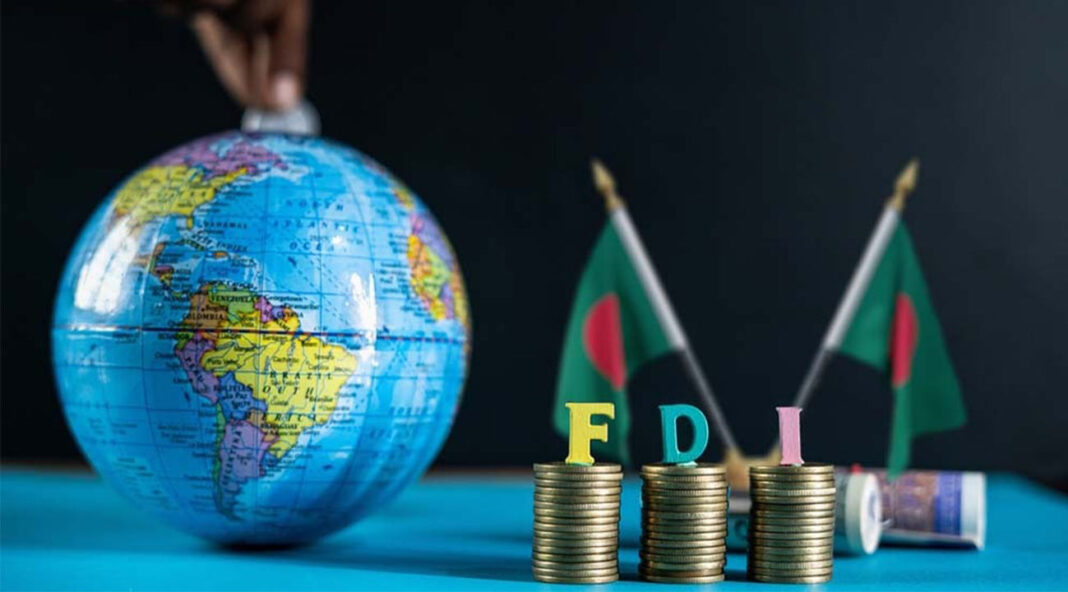
Bangladesh's economic narrative over the past two decades is one of remarkable resilience and upward mobility. Since its independence in 1971, the country has progressed from a subsistence agrarian economy to a lower-middle-income nation with a GDP exceeding USD 460 billion in 2024. A decisive factor in this transition has been the attraction and retention of foreign capital, primarily through Foreign Direct Investment.
FDI serves as a multifaceted engine of growth: it augments domestic capital formation, introduces advanced technology and managerial expertise, integrates host countries into global value chains, and stimulates local employment. For a developing economy like Bangladesh — characterised by a large labour force, a growing middle class, and an expanding domestic market — the strategic leveraging of FDI is of paramount importance.
Despite notable achievements, particularly in the RMG sector, Bangladesh's FDI inflows remain modest relative to regional peers such as Vietnam and India. This paper investigates why this gap persists and what policy interventions may bridge it. Section 2 reviews relevant literature. Section 3 presents empirical trends. Section 4 examines the regulatory environment. Section 5 analyses challenges. Section 6 explores opportunities. Section 7 concludes with policy recommendations.
Literature Review
The relationship between FDI and economic development has been extensively theorised. Dunning's (1981) Ownership-Location-Internalisation (OLI) paradigm remains foundational, positing that multinational enterprises invest abroad when they possess ownership advantages, find location-specific advantages in the host country, and benefit from internalising operations rather than licensing.
For developing economies, Borensztein et al. (1998) demonstrated that FDI fosters economic growth only when the host country possesses sufficient human capital — a finding particularly relevant to Bangladesh's expanding educated workforce. More recent scholarship by Alfaro et al. (2009) emphasises the role of local financial markets in enabling FDI's growth-enhancing effects.Country-specific studies on Bangladesh (Chowdhury, 2012; Islam & Hossain, 2018) highlight the primacy of the RMG sector in attracting export-oriented FDI, while noting persistent governance deficiencies as deterrents. Siddiqi (2022) argues that the establishment of SEZs under the Bangladesh Economic Zones Authority (BEZA) represents the most significant policy shift in FDI promotion in the post-2010 era.
FDI Trends in Bangladesh (2010–2025)
Aggregate Inflows
Bangladesh received USD 3.48 billion in FDI in the fiscal year 2022–23, representing a 16% increase from the prior year, according to BIDA. Historically, net FDI inflows grew from approximately USD 913 million in 2010 to a peak of USD 3.89 billion in 2019, before the COVID-19 pandemic caused a temporary contraction. Recovery has been steady, and 2024 projections indicate inflows approaching USD 4.2 billion.
Sectoral Distribution
The power and energy sector has attracted the largest cumulative FDI, reflecting Bangladesh's acute electricity deficit and government-led initiatives to expand generation capacity. The RMG and textile sector, while dominant in export earnings, attracts comparatively lower FDI due to its reliance on domestic entrepreneurship. Banking and financial services, telecommunications, and information and communication technology (ICT) collectively account for approximately 30% of total FDI stock. The pharmaceutical sector is an emerging recipient, driven by increasing domestic demand and export potential.
Source Countries
The United States, the United Kingdom, Singapore, South Korea, Japan, and China are among the principal source countries. Notably, Chinese FDI has surged since 2016, aligned with Bangladesh's participation in the Belt and Road Initiative (BRI). Japan's FDI is concentrated in the Araihazar Japanese Economic Zone, developed through the Japan International Cooperation Agency (JICA). India has also increased investment, particularly in power and manufacturing, facilitated by bilateral agreements.
Regulatory and Institutional Framework
Bangladesh has progressively liberalised its FDI framework since the 1980s. The Foreign Private Investment (Promotion and Protection) Act of 1980 guarantees repatriation of capital and profits, non-discriminatory treatment relative to domestic investors, and protection against nationalisation without fair compensation.
BIDA, established in 2016 through a merger of predecessor agencies, functions as the primary one-stop service authority. It offers online registration, import and export facilitation, utility connections, and work permit processing. Bangladesh's SEZs, governed by BEZA, provide additional incentives including tax holidays, duty-free import of capital machinery, and dedicated infrastructure.However, implementation gaps persist. The World Bank's 2023 Doing Business indicators placed Bangladesh at 168th globally, with particular weaknesses in contract enforcement, construction permitting, and property registration. These rankings signal systemic inefficiencies that deter prospective investors despite a nominally favourable legal framework.
Key Challenges to FDI Attraction
Infrastructure deficiencies represent the most frequently cited barrier in investor surveys. Unreliable power supply, inadequate port capacity at Chittagong, congested road networks, and limited rail freight connectivity increase operational costs and reduce competitiveness. While the Padma Bridge (inaugurated 2022) and Dhaka Metro Rail have improved connectivity, the investment gap in hard infrastructure remains substantial.Bureaucratic complexity and corruption present a second cluster of challenges. Multiple agencies — BIDA, BEZA, the National Board of Revenue, local government bodies — with overlapping mandates create opportunities for rent-seeking and delay. Streamlining inter-agency coordination is an acknowledged policy priority but progress has been incremental.Land acquisition poses a particularly acute problem. Densely populated and agriculturally productive, Bangladesh has limited land available for industrial use. Protracted acquisition processes and disputes over compensation deter large-scale industrial investments, particularly in manufacturing and logistics.
Labour market dynamics present a dual challenge. While wage rates remain competitive, the skills gap in technical and managerial roles is widening as industries upgrade technology. Labour unrest, particularly in the RMG sector, has periodically disrupted production and affected investor perceptions.
Strategic Opportunities
Bangladesh's demographic dividend — a median age of approximately 27 years and a labour force exceeding 70 million — positions it advantageously for labour-intensive manufacturing. As wage inflation in China and Vietnam accelerates, Bangladesh presents a compelling relocation option for export-oriented industries, particularly in electronics assembly, footwear, and light engineering.
The digital economy represents a transformative opportunity. Bangladesh's ICT sector has grown at over 20% annually, supported by government-led initiatives including the Digital Bangladesh Vision and the establishment of Hi-Tech Parks. Dhaka and Sylhet are emerging as software outsourcing and IT service delivery hubs, attracting both greenfield FDI and joint ventures.The 100 SEZs planned under the BEZA framework — of which 12 are operational as of 2025 — offer a vehicle to overcome infrastructure deficits through zone-level provision of power, water, sanitation, and connectivity. Successful zones such as those in Mirsarai and Araihazar demonstrate the model's viability and investor appetite.
Lastly, graduation from Least Developed Country (LDC) status, anticipated by 2026, while presenting tariff preference challenges, may simultaneously enhance Bangladesh's credibility and institutional standing among sophisticated investors who previously underweighted political and institutional risk.
Conclusion
Bangladesh stands at an inflection point in its development trajectory. The country's robust macroeconomic fundamentals, demographic endowment, and expanding SEZ infrastructure position it as a credible contender for increased FDI in the coming decade. However, realising this potential demands commensurate institutional reform. The gap between investment promotion rhetoric and operational reality — in regulatory efficiency, infrastructure, and governance — remains the most significant obstacle to Bangladesh ascending to the next tier of FDI recipients in South and Southeast Asia.
Comments 0
No comments yet. Be the first to comment!
Sign in to leave a comment.